Erich Friedrich Wilhelm Ludendorff  
(09.04.1865 - 20.12.1937)
place of birth:  Kruszewnia, Posen (Poland)
Königreich Preußen:  1.Gen-Quartiermeister,  AOK-Stabschef,  General der Infanterie


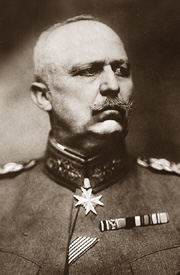
General Erich Ludendorff was arguably Imperial Germany's most significant military figure during the Great War. He was also one of only five recipients of the Grand Cross of the Iron Cross (1918).  Erich Ludendorff was born on 9 April 1865 as the third of six children born to Clara von Tempelhoff and August Wilhelm Ludendorff.  His father, who had been a cavalry captain in the reserves, had recently abandoned his small business and established himself as a gentleman farmer. Young Erich thus grew up on the humble family estate named Kruszewnia, located near the  town of Poznan in modern-day Poland. Although his family had lived in Prussia for more than 200 years, he was also of Swedish, Finnish and Polish heritage.

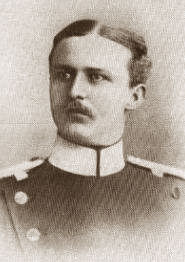
While his early years did not point toward a military career, Erich nevertheless entered the Royal Cadet School at Plön as a 12-year old boy. There he was studious and withdrawn, developing within himself the iron discipline which would serve him later during most of his military career. After two years in Plön, he transferred to the military academy at Gross-Lichterfelde near Berlin, and in 1882, at the age of seventeen, was commissioned a Sekonde-Lieutenant. His first posting was at Wesel where he served for about five years in 8. Westfälisches Infanterie-Regiment Nr. 57.

He then did a 3-year stint from 1887-90 in Wilhelmshaven with an elite unit of naval infantry troops, serving on the Niobe, the Baden, and the Kaiser, and sailing throughout Scandinavia and the British Isles. With a promotion to Premier-Lieutenant, he spent a short time in Frankfurt an der Oder attached to Leib-Grenadier-Regiment Nr. 8, but was soon sent to the Prussia's War College in Berlin for a three-year course with Russian as his main subject. In 1894, having done well with the language, he was sent to Russia to as a  military observer. He did his job well enough that on his return to Germany he was promoted to Hauptmann and assigned to the General Staff of the Army.

As such, Hauptmann Ludendorff was detailed to Great General Staff headquarters in 1895 and then to VI. Armee-Korps in Magdeburg. In 1898 he was transferred to Thorn as a company commander with Infanterie-Regiment ,,von der Marwitz” (8. Pommersches) Nr. 61.  He afterwards returned to General Staff of the Army and was detailed as Ia with 9. Infanterie-Division general staff in Glogau. Upon promotion to Major, we was detailed as Ia on the general staff of V. Armee-Korps in Posen. Returning to Great General Staff HQ in 1904, Ludendorff served under Count Alfred von Schlieffen, with the task of preparng the Imperial Army for mobilization. When Helmuth von Moltke replaced Schlieffen, Ludendorff was soon promoted to chief of the Second Department.  He ardently pressed for improved field communications, additional troops, heavy artillery, and aircraft. Many German political authorities did not look favorably upon his straight-forward manner, however, and Ludendorff's scheming and attempts to by-pass his chain of command made him many enemies in Berlin.


In the meantime, Erich met Margarethe Pernet Schmidt, the daughter of a wealthy industrialist, and quickly convinced her to leave her husband so that they could marry. Margarethe brought with her three sons and a daughter. They never had children of their own, but Erich treated Margarethe's children as his own. Because of the waves he had made Berlin, he and his new family were transferred to a relatively obscure posting in Düsseldorf. Here, as a newly-promoted Oberst, he took command of Niederrheinisches Füsilier Regiment Nr. 39.  During the months leading up to the War, he was promoted to Generalmajor and then transferred to command the infantry brigade in Strasbourg. In March 1914, Ludendorff's mother died, with apparently little effect on him. He was also still strongly disliked back in the capital, and with the threat of war, instead of being assigned as an army chief of staff, his mobilization orders had him serving as Oberquartiermeister (Senior Quartermaster) at Karl von Bülow's 2. Armee headquarters.

As the First World War broke out, Ludendorff accompanied the invasion force troops tasked which laying siege to the Belgian fortress city of Liege. When 14. Infanterie-Brigade commander von Wussow was killed in action, Ludendorff quickly took the initiative and led the14th as it fought  its way through the village of Queue-du-Bois. In the early morning hours of 7 August, he dispatched a staff officer into Liege to order the surrender of the Citadel. Ludendorff later arrived at the Citadel and pounded on the door, falsely believing it to be in German hands. The frightened Belgians were only happy to surrender to him, though, and for his quick thinking and intrepid actions, he was awarded the Pour le Merite and became a national hero. More importantly, German Supreme Command now saw Ludendorff as a proven, decisive leader and strategist. Thus, plans were quickly made to have him transferred to the 8. Armee-Oberkommando headquarters in order to team with the recently reactivated von Hindenburg and hopefully salvage Germany's precarious position on the Eastern Front.

At the Hannover train station on the morning of 23 August 1914, a most unlikely but successful and historic partnership was formed  -- von Hindenburg the solid old soldier from an aristocratic Prussian background, and the younger more volatile Ludendorff of more humble beginnings. They immediately began devising a strategy to save the 8. Armee and shore up the Eastern Front from an imminent Russian invasion. Most of their plan had already been worked out and implemented, however, by 8. Armee operations officer Max Hoffmann. Although von Hindenburg and Ludendorff were given the immediate credit for the tremendous victory at Tannenberg, where the Germans crushed the Russian Second Army, historians have largely decided that most of the credit was due to Hoffmann's expertise. The dynamic duo of Hindenburg-Ludendorff were nonetheless on their way to becoming cult heroes back home, a factor which would continually raise its head during the Great War and even on into the years leading up to the Second World War.


"General Ludendorff is a first-class man to work for. He is also the right man for this job: cold and ruthless."
 - Oberstleutnant Max Hoffmann
   Eighth Army Deputy Chief of Staff


"He (Ludendorff) is chilly, reserved, remote, almost wholly without charm. He seems devoid of any social instinct...a man of mystery."
 - H.L. Mencken, Aug 1917


"My children warmed to their new father from the very beginning. Their love and admiration for him grew even deeper as the War progressed."
 - Margarethe Pernet Ludendorff


By early November 1914, von Hindenburg and the newly-promoted Generalleutnant Ludendorff exercised supreme command of all Germans troops in the East from their headquarters Ober-Ost.  More victories followed on the Eastern Front with von Hindenburg giving his automatic approval to Ludendorff and Hoffmann's assault plans against the Russians. With Falkenhayn's failure at Verdun, von Hindenburg was sent to replace him in August 1916 as Chief of General Staff. Ludendorff naturally accompanied him, rejecting however the title of Deputy Chief of Staff. Instead, he created his own misleading designation as Erster Generalquartiermeister, First Quartermaster General. Continuing as von Hindenburg's deputy, he was assured that he'd have joint responsibility in all military decision making. At this point, Ludendorff was in fact the most authoritative military leader and was well on his way to controlling Germany's political scene as well.

In the spring of 1918, an increasingly stressed Ludendorff envisioned one last opportunity for Germany to make headway on the Western Front. Operations Michael and Georgette, carried out in March and April, punched through some 30 miles into enemy territory but eventually stalled. Over the next two months, operations Blücher-Yorck, Gneisenau, and Friedensturm quickly came to naught due lack of troops and supplies, not to mention the presence of fresh American soldiers. By the end of September, the Allies had pushed the Germans back to the Hindenburg Line once again, and Ludendorff's mental state continued its downward spiral. On 26 October, Kaiser Wilhelm II. accepted Ludendorff's angrily offered resignation but refused to let von Hindenburg go; Wilhelm was convinced that the old field marshal was an important symbol of German unity. Notably, General Ludendorff lost two sons during the War, both pilots: Franz (Sept 1917) and Erich (Mar 1918).

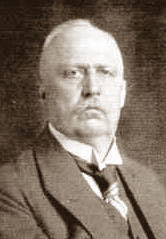
Two weeks later, General of Infantry Erich Ludendorff fled in disguise to Sweden where he penned My War Memories, but he returned to Germany and its volatile political scene by early 1919. Pressing ever further to the right, he then participated in the failed Kapp Putsch of 1920, as well as Hitler's Beer Hall Putsch in 1923. After divorcing his wife, Erich married Mathilde Spiess in 1926 and became increasingly involved in the occult, expressing agitation towards Jews, Catholics, and Free-Masons. He had also become bitter enemies with von Hindenburg. In 1936 he wrote Total War which expounded on his theory that modern war involved the whole nation. On 20 December 1937, at the age of 72, the most influential German leader during the Great War went to his deathbed in Tutzing, Bavaria.  Although Ludendorff was a member of the Nazi Party, he did warn of Hitler's tyranny shortly before his death. Despite this, Hitler paid final tribute to him by walking behind his swastika-draped casket.
 

"I will NEVER allow Ludendorff to become Chief of General Staff.  He is a dubious character, fired by personal ambition."
 - Kaiser Wilhelm II. to Bethmann-Hollweg, Jan 1915


1. Gen-Quartiermeister  29.08.1916  -  26.10.1918
General der Infanterie  29.08.1916

Pour le Mérite  08.08.1914   (Eichenlaub:  23.02.1915)
Großkreuz des EK  24.03.1918
Militär-St-Heinrich 07.05.1918  Großkreuz  (Ritter: 21.12.1914;  Komtur I: 13.11.1917)


Curriculum Vitae
   
01.07.1879 Preußische Hauptkadettenanstalt - Berlin/Groß-Lichterfelde
15.04.1881 Sekonde-Lieutenant  (Patent ante-dated from 15.04.1882)
15.04.1882 8. Westfälisches Infanterie-Regiment Nr. 57 - Wesel
14.03.1887 Militär-Turnanstalt - Berlin  (Student at Prussian Military Fitness Institute)
22.03.1887 Königlich Preußische Kaiser Wilhelm-Erinnerungs-Medaille (Zentenarmedaille)
14.04.1887 Kaiserlich Deutsche Marine - Kiel  (assigned to Imperial German Navy)
06.04.1888 S.M. Segelfregatte „Niobe“  (on board Imperial German Naval training vessel)
24.09.1888 Kaiserlich Deutsche Marine - Kiel
12.03.1889 Inspektion der Marine-Infanterie - Kiel  (Naval Infantry Inspectorate formed)
22.03.1889 1. See-Bataillon - Kiel  (detached to 1. Marine Battalion)
01.05.1889 S.M.S. Panzerschiff „Baden“  (on board Imperial German Ironclad Warship)
16.09.1889 1. See-Bataillon - Kiel  (return)
29.04.1890 S.M.S. Panzerschiff „Kaiser“  (on board Imperial German Ironclad Warship)
24.03.1890 Premier-Lieutenant
17.07.1890 2. See-Bataillon - Wilhelmshaven  (detached to 2. Marine Battalion)
12.08.1890 Leib-Grenadier-Regiment ,,Friedrich Wilhelm III.” (1. Brandenburgisches) Nr. 8 - Frankfurt a. O.
01.10.1890 Preußische Kriegsakademie - Berlin  (Student at Royal Prussian War College)
27.07.1893 Leib-Grenadier-Regiment ,,Friedrich Wilhelm III.” (1. Brandenburgisches) Nr. 8 - Frankfurt a. O.  (return from War College)
01.04.1894 Großer Generalstab - Berlin  (detached to Prussian Great General Staff HQ, from LeibGR-8)
22.03.1895 Hauptmann
22.03.1895 Generalstab der Armee - Berlin  (assigned to General Staff of the Army)
22.03.1895 Großer Generalstab - Berlin  (detailed to Great General Staff HQ, from GSdA)
19.03.1896 IV. Armee-Korps - Magdeburg  (detailed to Hänisch's General Staff, from GSdA)
01.04.1898 Infanterie-Regiment ,,von der Marwitz (8. Pommersches) Nr. 61 - Thorn  (Coy Cdr)
01.07.1900 Generalstab der Armee - Berlin  (assigned to General Staff of the Army)
01.07.1900 9. Infanterie-Division - Glogau  (detailed as Hahn's First General Staff Officer, Ia)
19.09.1901 Major
01.07.1902 V. Armee-Korps - Posen  (detailed as Stülpnagel's First General Staff Officer, Ia)
01.04.1904 Großer Generalstab - Berlin  (detailed to Great General Staff HQ as Sect Chief, from GSdA)
01.10.1906 Preußische Kriegsakademie - Berlin  (Instructor at Royal Prussian War College, Uniform GSdA)
15.04.1907 Königlich Preußischer Dienstauszeichnungskreuz für Offiziere - 25-jähriger
01.04.1908 Großer Generalstab - Berlin  (detailed to Great General Staff HQ as Dept Chief, from GSdA)
18.05.1908 Oberstleutnant
21.04.1911 Oberst
27.01.1913 Niederrheinisches Füsilier-Regiment Nr. 39 - Düsseldorf  (Cdr)
22.04.1914 Generalmajor
01.05.1914 85. Infanterie-Brigade - Straßburg i. E.  (Cdr)
   
Great War
   
02.08.1914 2. Armee-Oberkommando  (Bülow's Sr. Quartermaster)
08.08.1914 Orden Pour le Mérite
22.08.1914 8. Armee-Oberkommando  (Hindenburg's Chief of Staff)
18.09.1914 9. Armee-Oberkommando  (Hindenburg's Chief of Staff)
01.11.1914 Oberbefehlshaber Ost  (Hindenburg's Chief of Staff)
27.11.1914 Generalleutnant  =  Exzellenz
21.12.1914 Königlich Sächsischer Militär-St. Heinrichs-Orden - Ritterkreuz
00.00.1914 das Königlich Preußische Eiserne Kreuz 1914 - 2. Klasse
00.00.1914 das Königlich Preußische Eiserne Kreuz 1914 - 1. Klasse
23.02.1915 das Eichenlaub zum Orden Pour le Mérite
05.08.1915 Heeres-Gruppe Hindenburg  (Hindenburg's Chief of Staff)
00.00.1915 Königlich Württembergischer Militär-Verdienst-Orden - Komturkreuz
01.06.1916 à la suite:  Fusilier-Regiment „General Ludendorff“ (Niederrheinisches) Nr. 39
30.07.1916 Heeres-Front Hindenburg  (Hindenburg's Chief of Staff)
29.08.1916 General der Infanterie
29.08.1916 das Große Hauptquartier, Erster Generalquartiermeister - Schloß Pleß  (Deputy Chief of the General Staff, at OHL Great HQ)
11.02.1917 Erster Generalquartiermeister - Berlin  (at Berlin HQ with General Staff Ops Section)
17.02.1917 das Große Hauptquartier, Erster Generalquartiermeister - Spa, Belgium  (Deputy Chief of the General Staff, Great HQ relocated)
29.06.1917 Königlich Preußischer Roter Adler-Orden - Großkreuz mit Eichenlaub und Schwertern
28.07.1917 Kaiserlich Königlich Österreichisches Militär-Verdienstkreuz - Großkreuz mit Kriegsdekoration und Schwertern
13.11.1917 Königlich Sächsischer Militär-St. Heinrichs-Orden - Kommandeur 1. Klasse
18.03.1918 Erster Generalquartiermeister - Avesnes, Fra  (deploys with General Staff Ops Section)
24.03.1918 Großkreuz des Königlich Preußischen Eisernen Kreuzes
26.03.1918 Kaiserlich Königlich Österreichischer Militärischer Marie Theresien-Orden - Großkreuz
26.03.1918 Kaiserlich Königlich Österreichisches Große Goldene Militär-Verdienstmedaille am Bande des MVKs
07.05.1918 Königlich Sächsischer Militär-St. Heinrichs-Orden - Großkreuz
07.09.1918 das Große Hauptquartier, Erster Generalquartiermeister - Spa, Belgium  (returns to OHL Great HQ)
28.10.1918 zur Disposition gestellt
29.10.1918 Großherzoglich Oldenburgischer Haus- und Verdienst-Orden des Herzogs Peter Friedrich Ludwig mit Schwertern und Lorbeer
00.00.1918 Königlich Württembergischer Militär-Verdienst-Orden - Großkreuz
11.11.1918 Waffenstillstand von Compiègne  (Armistice)


 06.05.1914


*     *     *