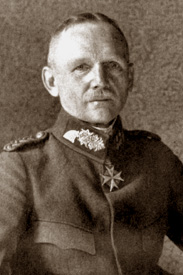
| |
|
|
14.04.1885 |
Sekonde-Lieutenant |
|
14.04.1885 |
4. Pommersches Infanterie-Regiment Nr. 21 - Bromberg/Thorn |
|
01.04.1887 |
Infanterie-Regiment Nr. 137 - Hagenau/Straßburg
i. E.
(assigned to III.Bn in Straßburg) |
|
19.09.1888 |
Deutsch-Ostafrikanische Gesellschaft - Dar es Salaam
(on extended leave with German East Africa Company) |
|
00.00.1889 |
Wissmann-Truppe in Deutsch-Ostafrika
(with Captain Wissmann's expeditionary Forces) |
|
12.08.1890 |
Infanterie-Regiment Nr. 137 - Hagenau/Straßburg
i. E.
(return from Africa) |
|
01.10.1891 |
Preußische Kriegsakademie - Berlin
(Student at Royal Prussian War College) |
|
14.09.1893 |
Premier-Lieutenant |
|
21.07.1894 |
Infanterie-Regiment „von Winterfeldt“ (2. Oberschlesisches) Nr. 23 -
Neiße
(return from War College) |
|
00.00.1895 |
Großer Generalstab - Berlin
(detached to Prussian Great General Staff HQ, from 2IR-23) |
|
22.03.1897 |
Königlich Preußische Kaiser
Wilhelm-Erinnerungs-Medaille (Zentenarmedaille) |
|
15.03.1898 |
Gouvernement des deutschen Schutzgebiets Kiautschau - Qingdao (detached for
duty in China, Kiautschou Bay Leased Territory) |
|
24.05.1898 |
Hauptmann |
|
18.02.1902 |
Infanterie-Regiment „von Boyen“ (5. Ostpreußisches) Nr. 41 -
Tilsit (Coy Cdr) |
|
17.05.1904 |
Generalstab der Armee - Berlin (assigned to
General Staff of the Army) |
|
17.05.1904 |
2. Infanterie-Division - Insterburg
(detailed
as Lüdinghausen's First General
Staff Officer, Ia) |
|
21.11.1904 |
Kaiserliche Schutztruppe für
Deutsch-Südwestafrika,
Etappenkommando
(Colonial Protection Forces SW Africa, L-O-C
GenStaff) |
|
21.11.1904 |
Herero Aufstand von 1904-1906 (Combatant
in Herero Wars, German SW Africa) |
|
16.03.1905 |
Major |
|
27.02.1906 |
Königlich Preußisches Erinnerungszeichen
zur Silbernen Hochzeit 1906 |
|
19.03.1907 |
Deutsches Reich: Südwest-Afrika Denkmünze
aus Bronze |
|
06.06.1907 |
Königlich Preußischer Kronen-Orden - 3.
Klasse mit Schwertern |
|
00.00.1907 |
Kaiserliche Schutztruppe für
Deutsch-Südwestafrika,
Kontrollbureau - Windhuk (Colonial
Protection Forces SW Africa) |
|
09.07.1908 |
Großherzoglich Mecklenburg-Schwerinsches
Militär-Verdienstkreuz - 2. Klasse |
|
14.04.1910 |
Königlich Preußischer
Dienstauszeichnungskreuz für Offiziere - 25-jähriger |
|
01.07.1910 |
Infanterie-Regiment „König Ludwig III. von Bayern“ (2. Niederschlesisches)
Nr. 47 - Posen (Bn Cdr,
return to Germany) |
|
22.03.1912 |
Oberstleutnant |
|
01.10.1912 |
3.
Ober-Elsässisches Infanterie-Regiment Nr. 172 -
Straßburg i. E. (Rgt
Staff Officer) |
|
15.06.1913 |
25-jährigen Regierungs-Jubiläum Wilhelm
II. |
|
16.06.1913 |
Kommandantur der Festung
Borkum (Commandant
of Fortress Borkum) |
|
23.04.1914 |
Oberst |
|
|
| Great
War |
| |
|
| 02.08.1914 |
Kommandantur der Festung
Borkum (Commandant
of Fortress Borkum) |
|
00.00.1914 |
das Königlich Preußische Eiserne Kreuz
1914 - 2. Klasse |
|
09.10.1915 |
Infanterie-Regiment „von Wittich“ (3. Kurhessisches)
Nr. 83
(Cdr) |
|
03.01.1916 |
92. Reserve-Infanterie-Brigade (Cdr) |
|
05.06.1916 |
185. Infanterie-Brigade (Cdr) |
|
23.07.1916 |
Königlich Preußischer Kronen-Orden - 2.
Klasse mit Schwertern am 3x weiß gestreiften Band |
|
03.05.1917 |
Offizier von der Armee (Officer of the
Army) |
|
20.06.1917 |
214. Infanterie-Brigade (Cdr) |
|
18.08.1917 |
Generalmajor |
|
01.10.1917 |
Orden Pour le Mérite |
|
20.01.1918 |
214. Infanterie-Division (Cdr,
replaced von Brauchitsch) |
|
03.05.1918 |
das Eichenlaub zum Orden Pour le Mérite |
|
11.11.1918 |
Waffenstillstand von Compiègne
(Armistice) |
| |
|
| |
|
| |
|
06.05.1914
|
| |
|

|
| |
|
*
* *
|
| |