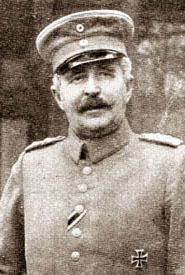
| |
|
|
04.10.1881 |
Offizier-Aspirant |
|
04.10.1881 |
Grenadier-Regiment
,,Prinz
Karl von Preußen” (2.
Brandenburgisches) Nr. 12 - Frankfurt a. O. |
| 13.05.1882 |
Portepée-Fähnrich |
| 13.02.1883 |
Sekonde-Lieutenant |
|
01.10.1888 |
Landwehr-Bezirkskommando
- Sorau (detached
as Adjutant to Territorial Reserves District Office) |
| 16.06.1891 |
Premier-Lieutenant |
|
01.10.1891 |
Preußische Kriegsakademie
- Berlin (Student at Royal Prussian War
College) |
|
21.07.1894 |
Grenadier-Regiment
,,Prinz
Karl von Preußen” (2.
Brandenburgisches) Nr. 12 - Frankfurt a. O. (return
from War College) |
|
24.07.1894 |
2. Hanseatisches Infanterie-Regiment
Nr. 76 - Hamburg |
| 01.04.1895 |
Großer Generalstab -
Berlin (detached to Prussian Great
General Staff, from 2IR-76) |
| 19.03.1896 |
Hauptmann |
| 19.03.1896 |
Generalstab der Armee - Berlin (assigned
to General Staff of the Army, aggregiert) |
| 19.03.1896 |
Großer Generalstab -
Berlin (detailed to Great
General Staff, from GSdA) |
|
29.10.1896 |
XI. Armee-Korps - Kassel (detailed
as Wittich's Second General Staff Officer, Ib) |
|
22.03.1897 |
Königlich Preußische Kaiser
Wilhelm-Erinnerungs-Medaille (Zentenarmedaille) |
|
27.11.1897 |
Orden der Königlich Italienischen Krone -
Offizierkreuz |
|
29.03.1899 |
Infanterie-Regiment ,,Graf
Schwerin”
(3. Pommersches) Nr. 14 - Graudenz (Coy Cdr) |
|
17.10.1900 |
Generalstab der Armee - Berlin (assigned
to General Staff of the Army) |
|
17.10.1900 |
4. Infanterie-Division -
Bromberg (detailed as Linde's First
General Staff Officer, Ia) |
| 12.09.1902 |
Major |
|
27.02.1906 |
Königlich Preußisches Erinnerungszeichen zur
Silbernen Hochzeit 1906 |
| 01.10.1902 |
Preußische Kriegsakademie
- Berlin (Instructor at Royal
Prussian War College) |
| 01.10.1906 |
Generalstab der Armee - Berlin (assigned
to General Staff of the Army) |
| 01.10.1906 |
XV. Armee-Korps - Straßburg
i. E. (detailed as
Hentschel's First General Staff Officer, Ia) |
|
13.05.1907 |
Königlich Preußischer Dienstauszeichnungskreuz für
Offiziere - 25-jähriger |
|
17.11.1908 |
Königlich Bayerischer Militär-Verdienst-Orden - 4.
Klasse mit Krone |
|
19.11.1908 |
Infanterie-Regiment ,,Graf
Tauentzien von Wittenberg”
(3. Brandenburgisches) Nr. 20 - Wittenberg (Bn Cdr) |
| 22.05.1909 |
Oberstleutnant |
| 22.03.1910 |
Infanterie-Regiment ,,Graf
Tauentzien von Wittenberg”
(3. Brandenburgisches) Nr. 20 - Wittenberg (Rgt
Staff Officer) |
| 21.04.1911 |
Generalstab der Armee - Berlin (assigned
to General Staff of the Army) |
| 21.04.1911 |
III. Armee-Korps - Berlin (detailed
as Bülow's Corps Chief of Staff) |
|
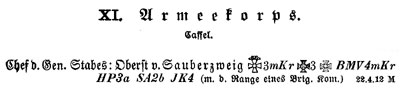
21.01.1912 |
Königlich Preußischer Roter Adler-Orden - 3.
Klasse mit der Schleife |
| 22.04.1912 |
Oberst |
|
19.09.1912 |
Krone zum Königlich Preußischen Roten Adler-Orden
- 3. Klasse mit der Schleife |
|
28.11.1912 |
Königlich Bayerischer Militär-Verdienst-Orden -
Komturkreuz 2. Klasse |
| 04.04.1913 |
Grenadier-Regiment
,,Prinz
Karl von
Preußen”
(2.
Brandenburgisches) Nr. 12 - Frankfurt a. O.
(Cdr) |
|
15.06.1913 |
25-jährigen Regierungs-Jubiläum Wilhelm II. |
|
16.06.1913 |
in den erblichen Adelstand erhoben (elevated
into Prussian nobility) |
| 01.02.1914 |
Offizier von der Armee (Officer
of the Army) |
| 03.02.1914 |
Rang eines Brigade-Kommandeurs |
| 03.02.1914 |
Generalstab der Armee - Berlin (assigned
to General Staff of the Army) |
| 03.02.1914 |
XI. Armee-Korps - Kassel
(detailed as Plüskow's Corps Chief of Staff) |
| |
|
| Great
War |
| |
|
| 02.08.1914 |
XI. Armee-Korps (Plüskow's
Corps Chief of
Staff) |
| 18.09.1914 |
9. Armee-Oberkommando (Hindenburg's
Deputy Chief of General Staff, Oberquartiermeister) |
| 24.12.1914 |
Generalmajor |
|
00.00.1914 |
das Königlich Preußische Eiserne Kreuz 1914 - 2.
Klasse |
|
00.00.1914 |
das Königlich Preußische Eiserne Kreuz 1914 - 1.
Klasse |
|
02.01.1915 |
Fürstlich Waldecksches Verdienstkreuz - 1. Klasse |
| 24.07.1915 |
III. Reserve-Korps (Beseler's Chief of
Staff) |
|
26.08.1915 |
Königlich Preußischer Roter Adler-Orden - 2.
Klasse mit Eichenlaub und Schwertern |
| 17.09.1915 |
Kaiserliches Deutsches General-Gouvernement
Belgien - Brüssel (Imperial
German General Govt of Belgium, Governor) |
| 27.06.1916 |
das Große Hauptquartier,
Generalquartiermeister - Berlin (GQM Freytag-Loringhoven's Chief of Staff) |
| 12.09.1916 |
das Große Hauptquartier,
Generalquartiermeister - Berlin (provisional
GQM) |
| 16.11.1916 |
8. Armee-Oberkommando (Mudra's
Chief of Staff) |
| 09.07.1917 |
Heeresgruppe Eichhorn
- Wilna (Eichhorn's Chief of Staff,
concurrent with below) |
| 06.09.1917 |
Orden Pour le Mérite |
| 09.09.1917 |
10. Armee-Oberkommando (Eichhorn's
Chief of Staff) |
| 27.12.1917 |
18. Armee-Oberkommando (Hutier's Chief of
Staff) |
|
23.03.1918 |
das Eichenlaub zum Orden Pour le Mérite |
| 07.05.1918 |
Königlich Sächsischer Militär-St. Heinrichs-Orden
- Ritterkreuz |
| 15.07.1918 |
Generalleutnant = Exzellenz |
| 16.07.1918 |
Königlich Preußischer Kronen-Orden - 2. Klasse mit
Schwertern |
| 07.08.1918 |
Offizier von der Armee (Officer
of the Army, convalescent leave) |
|
05.09.1918 |
Königlich Preußischer Kronen-Orden - 2. Klasse mit
Stern und Schwertern |
| 05.11.1918 |
Heeresgruppe Gallwitz
- Verdun (Gallwitz's Chief of Staff) |
|
11.11.1918 |
Waffenstillstand von Compiègne (Armistice) |
| 15.07.1919 |
zur Disposition gestellt |
| |
|
| |
|
| |
|
06.05.1914
|
| |
|
|
| |
|
*
* *
|
| |