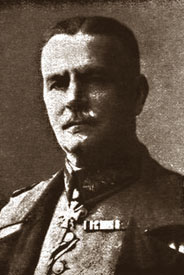
Günther Horst Sylvester Ritter und Edler von Oetinger  
(31.12.1857 - 27.09.1928)
place of birth:  Erfurt
Königreich Preußen:  KG,  Generalleutnant


Imperial German general officer Horst von Oetinger commanded an infantry division and IX. Armee-Korps during the Great War. He was born in Erfurt as the son of Prussian Generalmajor Günther Ritter und Edler von Oetinger and his spouse Franziska nee Klien. Son Horst enjoyed a pre-War carry as a staff officer, and just prior to mobilization in 1912, was promoted to Generalmajor and given command on 55. Infanterie-Brigade. At the outset of the War, he was nevertheless unable to to carry out field commander duties because of an illness, and was thus temporarily assigned to XIV. Armee-Korps headquarters in Karlsruhe.

Upon recovering, von Oetinger was sent to Liege, Belgium as head of the Landwehr-Division there. In late September, OHL dispatched him the Aisne region to take charge of 20. Infanterie-Division, engaged in trench warfare in support of General von Emmich's X. Armee-Korps. On the occasion of Kaiser Wilhelm's birthday in 1915, von Oetinger received a field promotion to Generalleutnant. In April, his division entrained for the Eastern Front and soon was engaged in the Bug Offensive in Galicia, fighting in support of 11. Armee-Oberkommando. At the end of that summer, General von Oetinger fell ill with cholera and was carried to the field hospital in Biala Piska.

Generalleutnant von Oetinger once again recovered from sickness and was transferred to Jakobstadt (Lithuania) to command the newly-established 109th Division, subordinate to 8. Armee-Oberkommando. Following a year of positional fighting, the 109th was transferred south to Romania in October 1916 to fight in the Vulkan Mountains with Erich von Falkenhayn's 9. Armee. The 109th enjoyed success against the Romanians during the Battle of Argesch in December 1916, as well as the Battle of the Putna in January 1917. Von Oetinger then found himself back on the Western Front, where he replaced General von Quast as commander of IX. Armme-Korps. His troops were engaged along the Siegfriedstellung (Hindenburg Line), at first in support of 1. Armee, then subordinate to 2. Armee. For the Spring Offensive of 1918, IX. Armee-Korps fought as part of 18. Armee-Oberkommando as they successfully broke through at St Quentin - La Fere and pushed on to the River Somme. For his distinguished service and leadership during this campaign, the Kaiser personally decorated hime in March 1918 with the highest Royal Prussian order of bravery, the Pour le Mérite.

IX. Armee-Korps continued battling along the Hindenburg Line during the summer of 1918, and in September were moved to Lorraine region to fight in the trenches alongside troops of the 10. Armee until War's end. After the Armistice signing in Compiegne, Generalleutnant von Oetinger returned with his corps to Altona for subsequent demobilization. He retired from active duty in 1919 and received an honorary promotion to the rank of General der Infanterie. Upon passing away in 1928, General von Oetinger was interred in the town of Baden-Baden.


Generalleutnant  27.01.1915

Pour le Mérite  26.03.1918


Curriculum Vitae
   
15.02.1877 Offizier-Aspirant
15.02.1877 3. Garde-Grenadier-Regiment ,,Königin Elisabeth - Spandau
15.09.1877 Portepée-Fähnrich
12.10.1878 Sekonde-Lieutenant
01.04.1881 3. Garde-Grenadier-Regiment ,,Königin Elisabeth - Spandau  (Bn Adjutant)
01.11.1886 3. Garde-Grenadier-Regiment ,,Königin Elisabeth - Spandau
01.10.1887 Preußische Kriegsakademie - Berlin  (Student at Royal Prussian War College)
22.03.1888 Premier-Lieutenant
21.07.1890 3. Garde-Grenadier-Regiment ,,Königin Elisabeth - Spandau  (return from War College)
01.04.1891 Großer Generalstab - Berlin  (detached to Prussian Great General Staff HQ)
25.03.1893 Hauptmann
31.03.1893 ,,Königin Elisabeth Garde-Grenadier-Regiment Nr. 3 - Spandau  (return from GGS, modified Rgt designation)
06.04.1893 ,,Königin Elisabeth Garde-Grenadier-Regiment Nr. 3 - Spandau  (Coy Cdr)
14.11.1895 Generalstab der Armee - Berlin  (assigned to General Staff of the Army)
14.11.1895 Großer Generalstab, Nebenetat - Berlin  (detailed to Great General Staff HQ)
01.10.1896 1. Infanterie-Division - Königsberg i. Pr.  (detailed as First General Staff Officer, Ia)
25.03.1899 Major
17.10.1899 V. Armee-Korps - Posen  (detailed as Stülpnagel's First General Staff Officer, Ia)
18.10.1902 Füsilier-Regiment ,,Königin (Schleswig-Holsteinisches) Nr. 86 - Flensburg  (aggregiert = Regimental asset)
22.11.1902 Füsilier-Regiment ,,Königin (Schleswig-Holsteinisches) Nr. 86 - Flensburg  (Bn Cdr)
16.03.1905 Generalstab der Armee - Berlin  (assigned to General Staff of the Army)
16.03.1905 V. Armee-Korps - Posen  (detailed as provisional Chief of Staff)
15.09.1905 Oberstleutnant
17.10.1905 V. Armee-Korps - Posen  (detailed as Stülpnagel's Chief of Staff)
01.05.1908 ,,Königin Augusta Garde-Grenadier-Regiment Nr. 4 - Berlin  (Cdr)
18.05.1908 Oberst
22.03.1912 Generalmajor
22.03.1912 55. Infanterie-Brigade - Karlsruhe  (Cdr)
   
Great War
   
02.08.1914 Offizier von der Armee   (Officer of the Army)
22.08.1914 Landwehr-Division Lüttich  (Cdr)
24.09.1914 20. Infanterie-Division  (Cdr, replaced Schmundt)
27.01.1915 Generalleutnant  =  Exzellenz
27.08.1915 convalescent leave, Feldlazarett Bialla
04.11.1915 109. Infanterie-Division  (Cdr, new formation)
11.12.1916 Stern zum Königlich Preußischen Roten Adler-Orden - 2. Klasse mit Eichenlaub und Schwertern
24.01.1917 IX. Armee-Korps  (Cdr, replaced von Quast)
26.03.1918 Orden Pour le Mérite
11.11.1918 Waffenstillstand von Compiègne  (Armistice)


06.05.1914


*     *     *