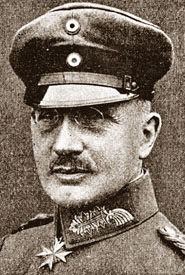
| |
|
| 23.04.1874 |
Portepée-Fähnrich
(charakter) |
| 23.04.1874 |
1. Großherzoglich Hessisches Infanterie- (Leibgarde-) Regiment Nr. 115 - Darmstadt |
| 12.12.1874 |
Portepée-Fähnrich
(Patent) |
| 12.10.1875 |
Sekonde-Lieutenant |
| 01.05.1882 |
Kadettenhaus zu Culm (detached
as instructor to Cadet School) |
| 01.05.1885 |
1. Großherzoglich Hessisches Infanterie- (Leibgarde-) Regiment Nr. 115 - Darmstadt |
| 12.11.1885 |
Premier-Lieutenant |
| 01.01.1888 |
Landwehr-Bezirkskommando - Darmstadt I
(detached as Adjutant to Territorial Reserves
District Office) |
| 01.01.1890 |
Leibgarde-Infanterie-Regiment
(1. Großherzoglich Hessisches) Nr. 115 - Darmstadt |
| 18.11.1890 |
Hauptmann |
| 18.11.1890 |
Leibgarde-Infanterie-Regiment
(1. Großherzoglich Hessisches) Nr. 115 - Darmstadt (Coy Cdr) |
|
22.03.1897 |
Königlich Preußische Kaiser
Wilhelm-Erinnerungs-Medaille (Zentenarmedaille) |
|
23.04.1899 |
Königlich Preußischer Dienstauszeichnungskreuz für
Offiziere - 25-jähriger |
| 18.01.1901 |
Major |
| 18.01.1901 |
Leibgarde-Infanterie-Regiment
(1. Großherzoglich Hessisches) Nr. 115 - Darmstadt (aggregiert
= Regimental asset) |
|
22.04.1902 |
Anhaltisches Infanterie-Regiment
Nr. 93 - Dessau (Bn Cdr) |
|
04.04.1904 |
Königlich Preußischer Johanniter-Orden -
Ehren-Ritterkreuz |
|
21.05.1907 |
Infanterie-Regiment „Kaiser Wilhelm“ (2.
Großherzoglich Hessisches) Nr. 116 - Gießen (Rgt
Staff Officer) |
| 20.07.1907 |
Oberstleutnant |
|
11.06.1909 |
Großherzoglich
Hessischer Ludewigs-Orden - Ritterkreuz 2. Klasse |
| 09.08.1910 |
Oberst |
| 09.08.1910 |
1. Hannoversches Infanterie-Regiment Nr. 74 -
Hannover
(Cdr) |
|
12.09.1910 |
Großherzoglich Hessischer Verdienst-Orden Philipps
des Großmütigen - Ehrenkreuz |
| 10.08.1913 |
40. Infanterie-Brigade - Braunschweig (provisional Cdr) |
| 01.10.1913 |
Generalmajor |
| 01.10.1913 |
40. Infanterie-Brigade -
Braunschweig (Cdr, replaced Ernst von Einem) |
| |
|
| Great
War |
| |
|
| 02.08.1914 |
40. Infanterie-Brigade (Cdr) |
| 23.08.1914 |
convalescent leave, severely wounded |
|
00.00.1914 |
das Königlich Preußische Eiserne Kreuz 1914 - 2.
Klasse |
|
00.00.1914 |
das Königlich Preußische Eiserne Kreuz 1914 - 1.
Klasse |
| 22.12.1914 |
87. Reserve-Infanterie-Brigade (Cdr) |
| 30.06.1915 |
3. Garde-Infanterie-Division (Cdr, replaced Graf von Schweinitz) |
|
06.10.1915 |
Schwerter zum Königlich Preußischen Roten
Adler-Orden - 2. Klasse mit Eichenlaub |
|
13.09.1916 |
Königlich Preußischer Kronen-Orden - 2. Klasse mit
Schwertern |
| 06.11.1917 |
Generalleutnant
= Exzellenz |
| 23.12.1917 |
Orden Pour le Mérite |
| 08.02.1918 |
XIV. Reserve-Korps (provisional
Cdr, replaced Moser) |
|
03.03.1918 |
Deutsches Reich: Verwundeten-Abzeichen in Schwarz |
| 15.06.1918 |
VII. Reserve-Korps (provisional
Cdr, replaced Wellmann) |
|
07.11.1918 |
Eichenlaub zum Orden Pour le Mérite |
|
11.11.1918 |
Waffenstillstand von Compiègne (Armistice) |
| 17.12.1918 |
zur Disposition gestellt |
| |
|
| |
|
| |
|
06.05.1914
|
| |
|
|
| |
|
*
* *
|
| |