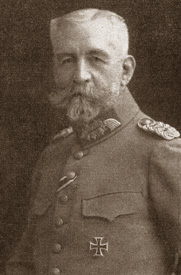
| |
|
|
08.02.1869 |
Sekonde-Lieutenant
(Patent ante-dated from 02.09.1870) |
| 18.04.1869 |
Offizier-Aspirant |
| 18.04.1869 |
2. Hessisches Husaren-Regiment Nr. 14 -
Kassel |
|
09.12.1869 |
Portepée-Fähnrich |
| 19.07.1870 |
Deutsch-Französischer Krieg von
1870–1871 (Combatant in
Franco-Prussian War) |
| 02.09.1870 |
Sekonde-Lieutenant
(original promotion) |
|
10.05.1871 |
2. Hessisches Husaren-Regiment Nr. 14 -
Kassel (return from Franco-Prussian War) |
| 16.06.1871 |
das Königlich Preußische Eiserne Kreuz 1870/71 -
2. Klasse |
| 18.06.1872 |
Rheinisches Dragoner-Regiment
Nr. 5 - Frankfurt a. M. |
|
01.10.1872 |
Militär-Reit-Institut -
Hannover (Student at Royal Prussian
Military Riding Institute) |
|
00.00.1872 |
Rheinisches Dragoner-Regiment
Nr. 5 - Frankfurt a. M. (return from
Riding Institute) |
| 01.10.1873 |
Preußische Kriegsakademie
- Berlin
(Student at Royal Prussian War College) |
| 14.12.1875 |
Premier-Lieutenant |
| 21.07.1876 |
Rheinisches Dragoner-Regiment
Nr. 5 - Hof-Geismar
(return from War College, Rgt HQ relocated in 1875) |
| 01.05.1879 |
Großer Generalstab -
Berlin (detached to Prussian
Great General Staff) |
| 03.05.1881 |
Rheinisches Dragoner-Regiment
Nr. 5 - Hof-Geismar |
|
26.08.1882 |
6-month
furlough in Greece |
| 13.03.1883 |
Rittmeister / Hauptmann |
| 15.03.1883 |
Generalstab der Armee - Berlin
(assigned to General Staff of the Army) |
| 15.03.1883 |
Großer Generalstab,
Nebenetat -
Berlin (detailed to Topographical Section
of Great General Staff, à l.s. GSdA) |
|
02.06.1883 |
Königlich Griechischer Erlöser-Orden -
Offizierkreuz |
| 11.03.1886 |
15. Infanterie-Division - Köln
(detailed as Hilgers' First General Staff Officer,
Ia) |
| 16.05.1888 |
Westfälisches
Ulanen-Regiment Nr. 5 - Düsseldorf
(Squadron Cdr) |
|
00.00.1888 |
Königlich Sächsischer Albrechts-Orden -
Ritterkreuz 1. Klasse |
| 22.03.1889 |
Major
(Patent ante-dated from 24.03.1890) |
| 24.03.1890 |
Major
(original promotion) |
| 24.03.1890 |
Generalstab der Armee - Berlin
(assigned to General Staff of the Army) |
| 24.03.1890 |
Großer Generalstab -
Berlin (detailed to Great
General Staff) |
|
29.10.1890 |
Königlich Sächsischer Albrechts-Orden -
Offizierkreuz |
|
21.01.1891 |
Königlich Preußischer Roter Adler-Orden - 4.
Klasse |
|
19.02.1891 |
Militärattaché, Deutsche Gesandtschaft -
Bern (detailed as Military
Attaché in Switzerland) |
|
25.02.1893 |
Großherrlich Türkischer Medschidié-Orden - 3.
Klasse |
|
07.06.1893 |
Königlich Preußischer Kronen-Orden - 3. Klasse |
| 14.05.1894 |
Oberst-Lieutenant |
| 14.05.1894 |
1.
Badisches Leib-Dragoner-Regiment Nr. 20 - Karlsruhe
(Cdr) |
|
09.12.1894 |
Königlich Preußischer Dienstauszeichnungskreuz für
Offiziere - 25-jähriger |
|
23.01.1895 |
Königlich Italienischer St. Mauritius- und
Lazarus-Orden - Offizierkreuz |
|
18.08.1895 |
Jubiläums-Eichenlaub „25“ 1870/1895 zum Eisernen
Kreuz 1870/91 - 2. Klasse |
|
18.03.1896 |
Großherzoglich Badischer Orden vom Zähringer Löwen
- Ritterkreuz 1. Klasse mit Eichenlaub |
| 22.03.1897 |
Königlich Preußische Kaiser
Wilhelm-Erinnerungs-Medaille (Zentenarmedaille) |
| 22.03.1897 |
Oberst |
| 10.09.1897 |
Generalstab der Armee - Berlin
(assigned to General Staff of the Army) |
| 10.09.1897 |
XVI. Armee-Korps - Metz (detailed
as Graf von Haeseler's Corps Chief of
Staff) |
|
30.03.1898 |
Großherzoglich Badischer Orden vom Zähringer Löwen
- Kommandeurkreuz 2. Klasse |
|
02.07.1898 |
Königlich Preußischer Roter Adler-Orden - 3.
Klasse mit der Schleife |
| 20.07.1898 |
Großer Generalstab -
Berlin
(detailed to Great General Staff,
Military History Section Chief, concurrent with below) |
| 20.07.1898 |
Preußische Kriegsakademie
- Berlin
(Instructor at Royal Prussian War College) |
|
16.11.1899 |
Rang eines Brigade-Kommandeurs |
|
24.01.1900 |
Königlich Preußischer Kronen-Orden - 2. Klasse |
| 12.08.1900 |
Generalmajor |
| 18.04.1901 |
31. Kavallerie-Brigade - Straßburg
i. E. (Cdr) |
|
22.01.1902 |
Königlich Preußischer Roter Adler-Orden - 2.
Klasse mit Eichenlaub |
|
10.01.1903 |
Orden der Königlich Rumänischen Krone -
Großoffizierkreuz |
|
18.06.1903 |
Stern zum Königlich Preußischen Kronen-Orden - 2.
Klasse |
| 24.04.1904 |
Generalleutnant
= Exzellenz |
| 24.04.1904 |
7. Infanterie-Division -
Magdeburg (Cdr, replaced Baron von
Ardenne) |
|
27.02.1906 |
Königlich Preußisches Erinnerungszeichen zur
Silbernen Hochzeit 1906 |
|
17.05.1906 |
Königlich Spanischer Militär-Verdienst-Orden -
Großkreuz |
|
28.08.1906 |
Königlich Sächsischer Albrechts-Orden - Großkreuz |
| 14.12.1907 |
VII. Armee-Korps - Münster (provisional
Cdr) |
| 27.01.1908 |
General
der Kavallerie |
| 27.01.1908 |
VII. Armee-Korps - Münster (Cdr, replaced Frh von Bissing) |
|
06.06.1908 |
Fürstlich Schaumburg-Lippischer Haus-Orden -
Ehrenkreuz 1. Klasse |
|
17.01.1909 |
Königlich Preußischer Roter Adler-Orden - 1.
Klasse mit Eichenlaub |
|
15.06.1909 |
Fürstlich Lippischer Haus-Orden - Ehrenkreuz 1.
Klasse |
|
01.09.1909 |
zur
Disposition gestellt |
|
21.09.1909 |
Königlich Preußischer Roter Adler-Orden -
Großkreuz mit Eichenlaub |
| |
|
| Great War |
| |
|
| 02.08.1914 |
V. Armee-Korps - Posen, Stellvertrender
KG (Acting Cdr at V. Corps HQ) |
|
00.00.1914 |
das Königlich Preußische Eiserne Kreuz 1914 - 1.
Klasse |
|
14.06.1915 |
das Königlich Preußische Eiserne Kreuz 1870 - 2.
Klasse Wiederholungsspange |
| 04.09.1915 |
49. Reserve-Division (Cdr, replaced Hahndorff) |
|
18.03.1916 |
Königlich Bayerischer Militär-Verdienst-Orden - 1.
Klasse mit Schwertern |
| 06.06.1916 |
Korps Bernhardi (Cdr,
formed with German and Austrian troops) |
|
20.08.1916 |
Orden Pour le Mérite |
| 01.10.1916 |
General-Kommando z.b.V. Nr. 55 (Cdr,
redesignated from Korps Bernhardi) |
|
15.05.1918 |
das Eichenlaub zum Orden Pour le Mérite |
|
11.11.1918 |
Waffenstillstand von Compiègne (Armistice) |
| |
|
| |
|
| |
|
06.05.1909
|
| |
|

|
| |
|
*
* *
|
| |